




What this page covers
- Facts checked
- Sources
- 12 listed, with access dates
- Screenshots
- 3 dated public-page captures
- Score
- No numeric score on this page
Public vendor pricing pages, FAQs, license page, company pages and announcements read on 7 Nov 2026; checked in an AI-assisted research browser; sliders and billing toggles set by the research pass and captured logged out from Pakistan at 1440x900. One official n8n demo sampled at two timestamps.
What I checked
- Pricing pages and billing toggles for all three
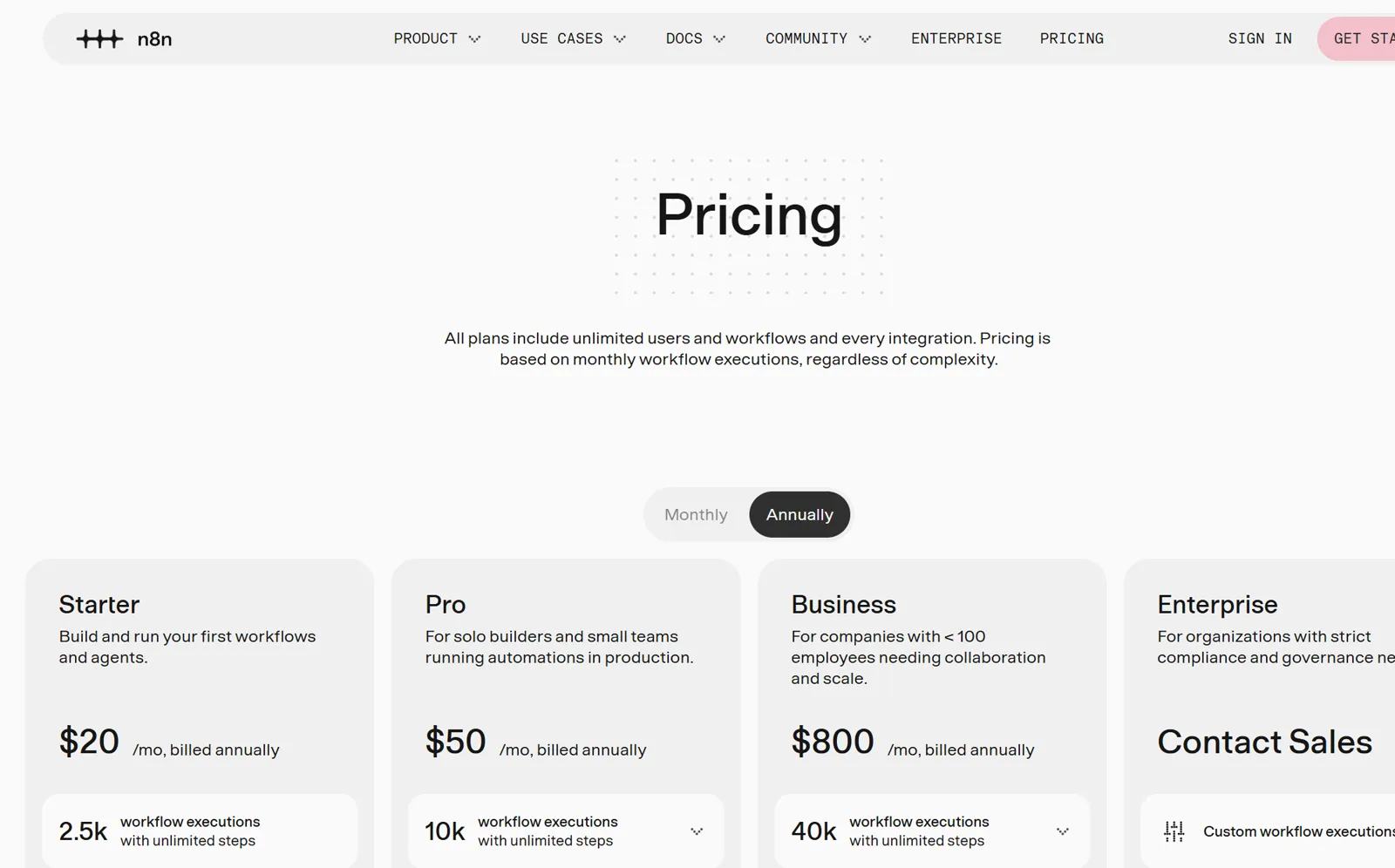
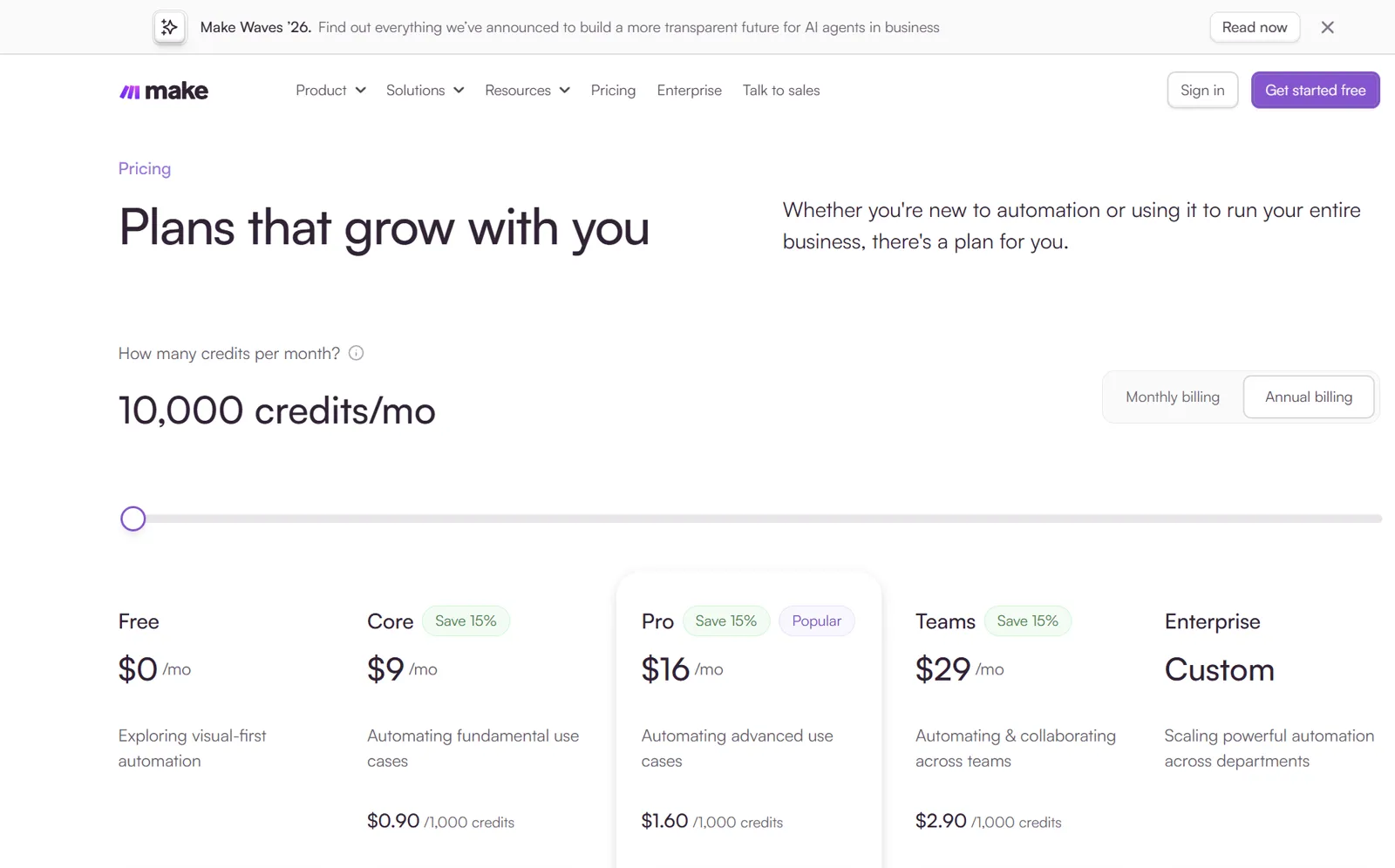
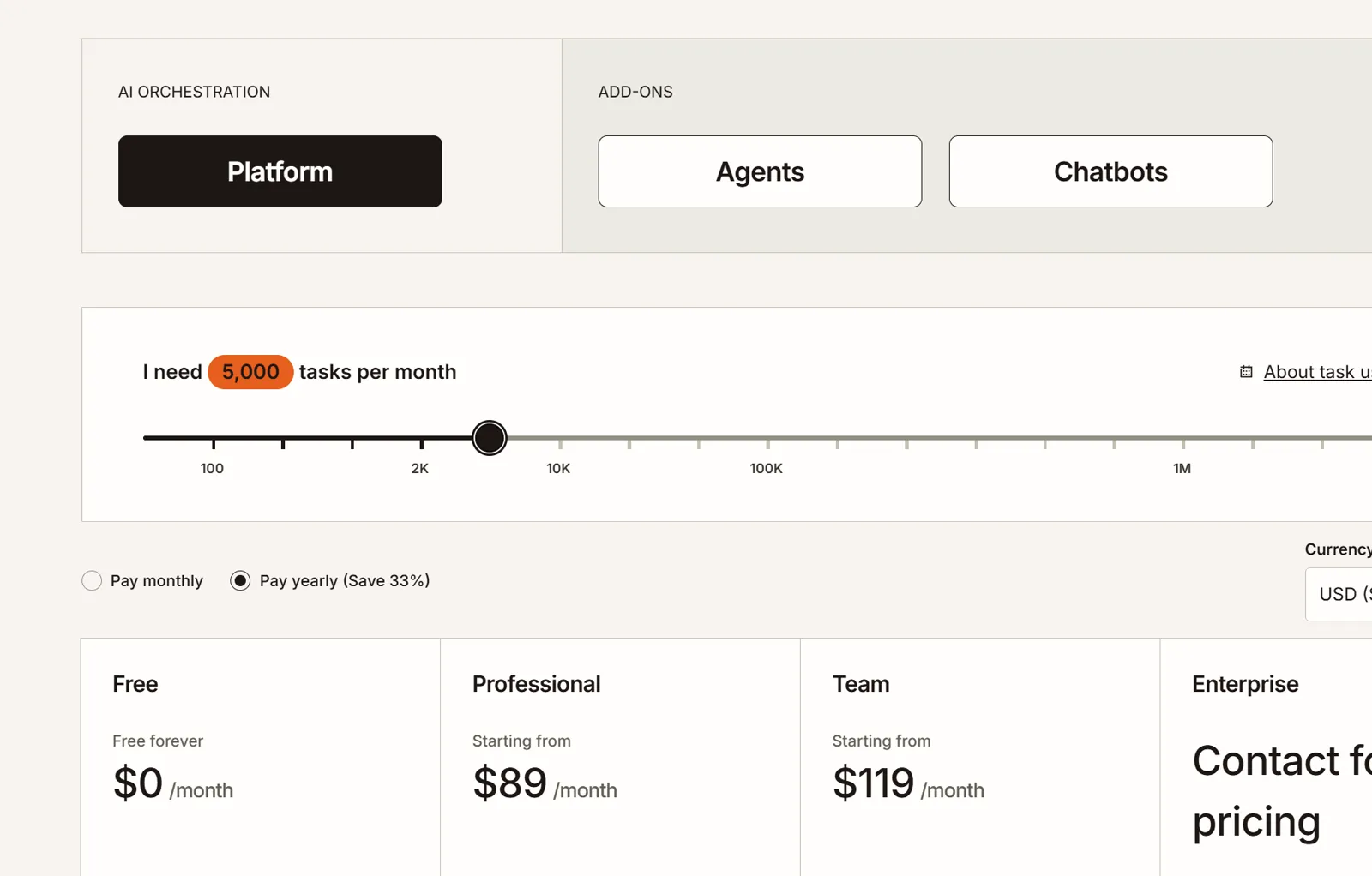
- n8n monthly and annual prices; Make monthly and annual; Zapier at 5,000 tasks monthly and yearly
Not covered
- No account testing was performed for this review
- No workflows run, no API calls, no credits spent
- No official Make or Zapier demo observed
How to decide in two questions
First question: how many steps does one lead touch? Each tool counts a different thing. n8n counts one execution per complete workflow run (n8n pricing). Make counts credits, and most module actions use one credit, including reading data from a webhook (Make pricing FAQ). Zapier counts a task for each successful action, and triggers are free (Zapier pricing FAQ). The more steps per lead, the more that difference matters.
Second question: who has to touch it? Zapier's Free and Professional plans are for one user, and Team allows 25. n8n lists unlimited users on every plan, and so does Make's compare table (Make compare table). If you build automations for clients, n8n's license allows it: n8n says you are "free to offer commercial consulting or support services (e.g. building n8n workflows) without the need for a separate license agreement". Hosting n8n for your customers so they can connect their own accounts and build workflows, or embedding it in a product you sell, needs a commercial agreement (n8n license page).
Scorecard at a glance
| Pillar and weight | n8n | Make | Zapier | Evidence held |
|---|---|---|---|---|
| UI and UX, 25 | n/s | n/s | n/s | Public pricing pages; one vendor demo for n8n only |
| Capability for GTM jobs, 30 | n/s | n/s | n/s | Vendor pricing pages and FAQs |
| Cost and pricing, 15 | n/s | n/s | n/s | Dated public prices, no metered usage |
| Technical fit, 15 | n/s | n/s | n/s | Published limits, no API calls |
| Vendor durability, 15 | n/s | n/s | n/s | Company pages and announcements |
That leaves 0 of 100 points scored and no overall winner.
What each one is
n8n is a workflow automation platform you can use on n8n's cloud or host yourself. Its founder, Jan Oberhauser, wrote in May 2026 that he started it "almost seven years ago" (source). The code is source-available under the Sustainable Use License, and n8n says it does not call itself open source (source).
Make is a visual automation platform where a workflow is called a scenario. Make says it "is part of Celonis" and has run "since 2015" (source). It started life as Integromat, which Celonis bought in October 2020 (TechCrunch).
Zapier calls its workflows Zaps. Its pricing page now puts Zaps, Tables, Forms, MCP and an SDK on one shared task pool (source). The Y Combinator directory lists Zapier in the Summer 2012 batch and says it was founded in 2011 (source).
How these facts were checked
On 7 November 2026 each vendor's pricing page, FAQ and company page were checked in an AI-assisted research browser; the research pass set the price sliders and billing toggles and saved screenshots of what the pages showed. The browser ran from Pakistan at a 1440 by 900 desktop viewport, logged out. No account testing was performed for this review: no one signed up, connected a CRM, ran a workflow or spent product credits. So I can tell you what each vendor documents, and I cannot tell you about speed, reliability or output quality.
n8n shows prices in US dollars to the research browser and has no currency switch on the page. A server-side read of the same page on the same day returned euro prices of 20, 50 and 667 per month for Starter, Pro and Business (n8n pricing). I quote the dollar prices below and you should check the page from your own region.
What the public pages and the demo show
Observed in vendor demo: in n8n's quick start video on YouTube (n8n and Flowgrammer), at about 12:28 the empty canvas offers "Add first step" or "Build with AI", and the trigger list includes "On app event", "On a schedule", "On webhook call", "On form submission" and "On chat message". At about 13:00 the editor shows Editor, Executions and Evaluations tabs and an AI Nodes panel listing AI Agent, Anthropic, Google Gemini, Guardrails, Ollama and OpenAI. That is the vendor's own recording. The research pass did not find an official Make or Zapier demo, so there is no equivalent observation for them.
Design and layout rating
All five UI criteria are n/s for all three tools. The rubric asks for timed onboarding and repeated page loads in a product account, and this review has neither.
Capabilities for GTM automation
| Capability | n8n | Make | Zapier |
|---|---|---|---|
| App catalogue | "every integration" on all plans (n8n) | "3,500+ apps" on the Free plan card; the FAQ on the same page says "more than 1,000" (Make) | "9,000+ apps" (Zapier) |
| Code in a workflow | JS and Python code steps (n8n) | Make Code App (JavaScript or Python) from Core up, 2 credits per second of execution; not included on Free (Make compare table) | Code steps billed in tasks (Zapier) |
| AI agents | AI Agent node, human approval for tool calls (n8n) | Make AI Agents (beta) on all plans, with Make's AI Provider or your own LLM key; AI Provider features may use more than 1 credit (Make compare table) | AI steps; Agents sold as an add-on (Zapier) |
| MCP | MCP Server Trigger and MCP Client (n8n) | Make MCP Server, "Included" on all five plans (Make compare table) | Zapier MCP, 2 tasks per tool call (Zapier) |
| Self-hosted edition | Community Edition (n8n) | Not checked beyond the plan table | Not checked beyond the plan table |
For lead routing and enrichment, check two rows before anything else: whether your CRM and data tools are in the catalogue, and whether you can drop to code when they are not. Specific CRM connectors were not verified for any of the three.
Technical limits
n8n Starter allows 5 concurrent executions and a 5 minute maximum run; Pro allows 20 or 50 concurrent and 40 minutes. Saved executions cap at 2.5k on Starter, 25k on Pro and 50k on Enterprise, and Git version control sits on Business and Enterprise (n8n).
Make gives you 5 GB of data transfer and a webhook queue of 667 for each 10,000 credits, with a 10,000 queue maximum. Router and error handler modules use no credits. The Free plan has a 15 minute minimum interval between runs, and Core adds access to the Make API (Make).
Zapier does not charge tasks for triggers, polling, failed actions or built-in tools such as Filter, Formatter, Paths, Delay and Looping. Its SDK is "free while in beta" (Zapier).
Pricing, with one worked lead flow
| Plan and allowance | Billed annually | Billed monthly |
|---|---|---|
| n8n Starter, 2.5k executions | $20 (n8n) | $24 (n8n) |
| n8n Pro, 10k executions | $50 (n8n) | $60 (n8n) |
| Make Core, 10,000 credits | $9 (Make) | $10.59 (Make) |
| Make Pro, 10,000 credits | $16 (Make) | $18.82 (Make) |
| Zapier Professional, 5,000 tasks | $89 (Zapier) | $133.50 (Zapier) |
| Zapier Team, 5,000 tasks | $119 (Zapier) | $178.50 (Zapier) |
Here is my arithmetic for one hypothetical flow: a webhook trigger plus five standard actions, run 1,000 times a month, with no AI or code steps. n8n counts 1,000 executions, which fits Starter at $20 billed annually. Make counts about 6,000 credits, because reading the webhook costs a credit and so does each action. That fits the 10,000 credit Core plan at $9 billed annually. Zapier counts 5,000 tasks if each action uses one task, because the trigger is free; Zapier notes that "Some apps or actions may use more than one task". That is Professional at $89 billed annually (n8n, Make, Zapier).
This compares billing units for one flow. The plans are not equivalent products: Zapier Professional is one user, n8n Starter stops runs at 5 minutes, and Make's AI and code steps cost more than one credit. AI steps add usage on all three. Make says features using its AI Provider may use more than one credit, and Zapier bills AI steps and code at task-based usage rates. On n8n the run still counts as one execution, and AI has its own allowances. Starter includes 1,600 credits a month for n8n's Assistant (preview) and Pro up to 9,600. For AI steps inside workflows, Starter and Pro list "AI models without API keys", with gateway credits included (Make, Zapier, n8n). This review did not find how many gateway credits a model call uses.
Overage rules differ too. Make pauses scenarios when credits run out, and credits expire at the end of the term. Make's compare table lists "Credits usage flexibility with yearly billing", annual credits that "only expire after 12 months instead of each month", on Pro, Teams and Enterprise only, not on Free or Core. So the Core plan in my example does not get that flexibility even when billed annually (Make compare table). Zapier moves you to pay-per-task "at a higher per-task rate" unless you switch that off. n8n lists overage as "Capped" on Starter and Pro (Make, Zapier, n8n).
Company and operations
| Fact | n8n | Make | Zapier |
|---|---|---|---|
| Ownership | Independent, venture-backed (source) | Part of Celonis (source) | Independent, YC Summer 2012 (source) |
| Funding and valuation | $180M Series C led by Accel at $2.5B, October 2025, $240M total (source); SAP investment at a $5.2bn valuation, May 2026, amount not stated (source) | Make describes Celonis as "valued at $13 billion" (source) | Not verified from a primary source |
| Revenue | "10x revenue growth" over the year to October 2025, no absolute figure (source) | Not reported separately | Not published by Zapier |
| People | Not covered | "over 380 employees" and, lower on the same page, "over 350 Makers" (source) | "800+ people across 38 countries" (source); the YC directory lists 700 (source) |
| Reach, company-stated | 1.7 million monthly active builders and 1,400+ enterprise customers (source) | 500k customers (source) | 3.4 million companies (source) |
On shipping: n8n announced in May 2026 that it would be embedded in SAP's Joule Studio (source). Zapier CEO Wade Foster posted on X on 4 November 2026, and Zapier's account quoted it on 6 November 2026 (UTC; 7 November in Pakistan): "Next Gen Zaps fix themselves when they break. In just one week, that saved 100,000 tasks that would have failed" (post). That figure is company-reported and this review could not check it. When Celonis bought Integromat in 2020, its CEO told TechCrunch the price was "over $100 million" (source). Third-party revenue estimates for n8n and Zapier disagree with each other, so I left them out.
What each does well and badly
n8n does well on cost per run for long flows, self-hosting, MCP on every plan and unlimited users (n8n). Its weak spot is licensing for product builders: making n8n available to your customers to build their own workflows, or embedding it in a product you sell, needs a commercial agreement, while building workflows for clients as a consultant does not (n8n license page). Starter runs stop at 5 minutes, the hosted Business plan shows a waitlist and is labelled "Self-hosted only", and email support starts at Enterprise (n8n).
Make has the lowest entry price here, $9 a month billed annually for 10,000 credits, its routers and error handlers are free, and the MCP Server is included on every plan (Make compare table). The catch is that every module costs credits, reads included, so long scenarios add up, and scenarios stop when credits run out.
Zapier has the largest catalogue at 9,000+ apps and does not charge for triggers, failed actions or built-in tools. It also offers a 14-day Professional trial with no card (Zapier). On the downside, Free and Professional are single-user, overage costs more per task, each MCP tool call uses two tasks, and the 5,000 task tier costs $89 a month billed annually against $20 for n8n Starter.
Who should pick which
- Pick n8n if your lead flows run many steps or you want to self-host for data control. Building workflows for clients is allowed; hosting or embedding n8n for customers needs a commercial agreement.
- Pick Make if your scenarios are short, you want the cheapest entry plan, and someone will watch credit use.
- Pick Zapier if a niche sales or marketing app you depend on is in its catalogue and nowhere else, and per-step cost matters less to you than setup time.
If two tools pass both questions at the top of this page, build the same small flow on each free plan or trial before you pay. This review has not done that.
FAQ
Is n8n open source?
n8n says no. Its code is source-available under the Sustainable Use License, and n8n uses the term fair-code instead (source).
Does Zapier charge for triggers?
No. Zapier says triggers and polling do not count toward your task limit; only successful actions do (Zapier).
What happens when Make runs out of credits?
Scenarios stop until you add credits. Incoming webhooks wait in the queue up to your queue size and run when scenarios resume (Make).
Do I need to code?
Zapier's FAQ answers "Do I need to know how to code?" with "Nope!" (Zapier). n8n and Make both offer visual editors with optional code or custom API steps (n8n, Make).
Disclosure, gaps and changelog
No account testing was performed for this review. Source links on this page go directly to the vendors' official pages and the cited publications. No product credits were spent in this review. FAQ questions come from topics the vendors answer in their own FAQs.
Known gaps: no hands-on tests; Zapier funding and revenue not verified from a primary source; Make founders and standalone revenue not covered; n8n headcount not covered; changelogs and status pages not reviewed; no official Make or Zapier demo observed; specific CRM connectors not verified.
Changelog: 7 November 2026, first version.
Sources
| Ref | Source | Published by | Accessed |
|---|---|---|---|
| n8n-pricing | n8n Plans and Pricing | n8n | |
| n8n-license | Sustainable Use License | n8n | |
| n8n-seriesc | n8n raises $180m to get AI closer to value with orchestration | n8n | |
| n8n-sap | Announcing SAP's strategic investment in n8n | n8n | |
| make-pricing | Pricing & Subscription Packages | Make (Celonis) | |
| make-about | About Make | Make (Celonis) | |
| tc-integromat | Celonis acquires Czech startup Integromat to accelerate move to process automation | TechCrunch | |
| zapier-pricing | Plans & Pricing | Zapier | |
| zapier-about | About Zapier | Zapier | |
| yc-zapier | Zapier, Y Combinator company directory | Y Combinator | |
| x-zapier | Zapier post quoting Wade Foster on Next Gen Zaps | Zapier (X) | |
| yt-n8n | n8n Quick Start Tutorial: Build Your First AI Agent [2026] | n8n and Flowgrammer (YouTube) |