

What this page covers
- Facts checked
- Sources
- 10 listed, with access dates
- Screenshots
- None on this page
- Score
- No numeric score on this page
AI-assisted research pass. Published definitions (Clay, Salesforce, The Pragmatic Engineer), six job posts read from employer job boards through the public Ashby and Greenhouse posting feeds on 7 Nov 2026, and one captured Clay X article. Small hand-picked sample; no pay, survey or prevalence claims. The author working definition is labelled as his own. The handoff diagram is drawn from job post text with source IDs.
Three jobs that meet at revenue
A GTM engineer builds systems that create and move pipeline: scoring, enrichment, routing and outbound plays that run without someone doing each step by hand [2]. RevOps runs the revenue machine itself: CRM data, forecasts, quotas, territories, comp plans and quote to cash [5] [6]. A growth engineer writes product code and runs experiments on signup, onboarding, activation and retention [7] [8].
Their work meets in a few predictable places, covered in the handoff section below. Companies use these titles differently.
At a glance
| Question | GTM engineer | RevOps | Growth engineer |
|---|---|---|---|
| Main question | How do we create and route more qualified pipeline with less manual work? [2] | Is the revenue process clean, predictable and on plan? [5] [6] | Do more users sign up, activate and stay? [7] [8] |
| Typical output | Running workflows: scoring, enrichment, routing, triggers [2] | Clean CRM, forecasts, plans, quote-to-cash rules [5] [6] | Shipped experiments, onboarding flows, instrumentation [7] [8] |
| Department in the posts | Clay's Revenue Platform [2] [3] | Reports to finance at Hologram; Strategy and Planning team at ClickHouse [5] [6] | Product at ClickHouse, Engineering at Circleback [7] [8] |
| Systems named | Clay, Salesforce, HubSpot, Marketo, APIs and webhooks [2] [3] | Salesforce, CPQ, BI tools, comp platforms, SQL [5] [6] | TypeScript, React, Node, A/B testing tools [7] [8] |
Some of these posts list pay ranges. We left pay out: six posts cannot tell you what the market pays.
Where each title comes from
GTM engineer. Clay says it "coined the role in 2023" and defines GTM engineering as "the practice of building automated revenue systems with AI, data, and workflow automation, instead of running go-to-market by hand" [1]. Clay sells the tool at the centre of that definition, so read it as a vendor's framing.
RevOps. Salesforce calls revenue operations "a strategic framework that brings together all revenue-related activities in an organization", spanning marketing, sales, customer success and finance, and treats sales operations as a subset of it [4].
Growth engineer. Alexey Komissarouk, former head of growth engineering at MasterClass, writes that "growth engineering is the writing of code to make a company money", and traces growth teams to a Facebook story from 2007 [9].
How we researched this
- Process: an AI-assisted research pass reviewed the publicly accessible portions of the sources below; no product or job-board accounts were used.
- Definitions: Clay's GTM engineering guide [1], Salesforce's RevOps guide [4] and a growth engineering deep dive in The Pragmatic Engineer [9].
- Job posts, read on 7 November 2026 through each employer's public job board: Clay, GTM Engineer, Marketing [2]; Clay, GTM Engineer, Systems and Infrastructure [3]; Hologram, Revenue Operations Manager [5]; ClickHouse, Senior Analyst, Revenue Operations [6]; ClickHouse, Growth Engineer [7]; Circleback, Growth Engineer [8].
- One captured X article from Clay's company account [10].
- Six posts make a small, hand-picked sample. They show how these companies write the roles. They do not show how common any duty is.
- Left out: pay, headcount trends and survey data.
GTM engineer in real job posts
Clay's Marketing post asks the hire to "build and own top-of-funnel workflow automations like lead and account scoring, intent and buying-signal detection, inbound enrichment and routing, speed-to-lead triggers" [2]. The same hire owns the instrumentation behind MQL definitions and the marketing funnel.
Clay's Systems and Infrastructure post reads closer to classic RevOps. It covers Salesforce objects, flows, validation rules, and CPQ and billing workflows, and asks the hire to engineer Clay's own internal instance "for maximal scale and reliability" [3].
Both posts ask for 6 to 10 years across fields such as RevOps, marketing ops or GTM engineering, and for the ability to build with "Python, JavaScript, SQL, or TypeScript" [2] [3].
RevOps in real job posts
Hologram's Revenue Operations Manager owns "Salesforce, a bespoke CPQ, contract and billing integrations, and the reporting that Sales, Finance, and leadership use to run the company every week" [5]. The role reports to the Director of Finance and runs "RevOps as a function of one with engineering support".
ClickHouse describes its Senior Analyst, Revenue Operations as "the operational counterpart to FP&A inside Revenue Operations". The work covers the annual planning cycle, headcount and expense tracking, comp plan modelling, forecast roll-ups, and territory and quota support, and the post requires SQL [6].
In both posts RevOps owns the numbers that leadership plans with and pays commission on, plus the systems that keep those numbers right.
Growth engineer in real job posts
ClickHouse places its Growth Engineer in Product. The hire builds "experimentation infrastructure, onboarding flows, and product surfaces across the self-serve funnel", in standard UI and in AI-assisted flows, with TypeScript, Node.js and React [7].
Circleback's first growth hire will "focus on what happens inside the product". That covers the loop from the notes a non-user receives after a meeting through signup, onboarding and activation, plus event instrumentation, attribution, dashboards and A/B tests [8].
Both growth engineers ship production code. Neither post mentions sales process or CRM work.
Responsibilities side by side
| Work | GTM engineer | RevOps | Growth engineer |
|---|---|---|---|
| Lead and account scoring, enrichment, routing | Owns [2] | Lead routing and BDR-to-AE handoff at Hologram [5] | Not named |
| CRM data model and admin | Owns at Clay [3] | Owns at Hologram [5] | Not named |
| CPQ, billing, quote to cash | Builds at Clay [3] | Owns at Hologram [5] | Not named |
| Forecasts, quotas, territories, comp | Not named | Runs comp and forecast roll-ups, supports quotas and territories, at ClickHouse [6] | Not named |
| Funnel instrumentation and attribution | Marketing funnel [2] | Reporting layer [5] | Product funnel [7] [8] |
| Product onboarding and activation | Not named | Product activation not named; Hologram automates the customer path from quote to contract to onboarding to renewal [5] | Owns [7] [8] |
| Code asked for | Python, JavaScript, SQL or TypeScript [2] | SQL at ClickHouse [6] | Production TypeScript and React [7] |
Where the work changes hands
The useful question is where one role's output becomes another role's input. Four handoffs stand out in the posts.
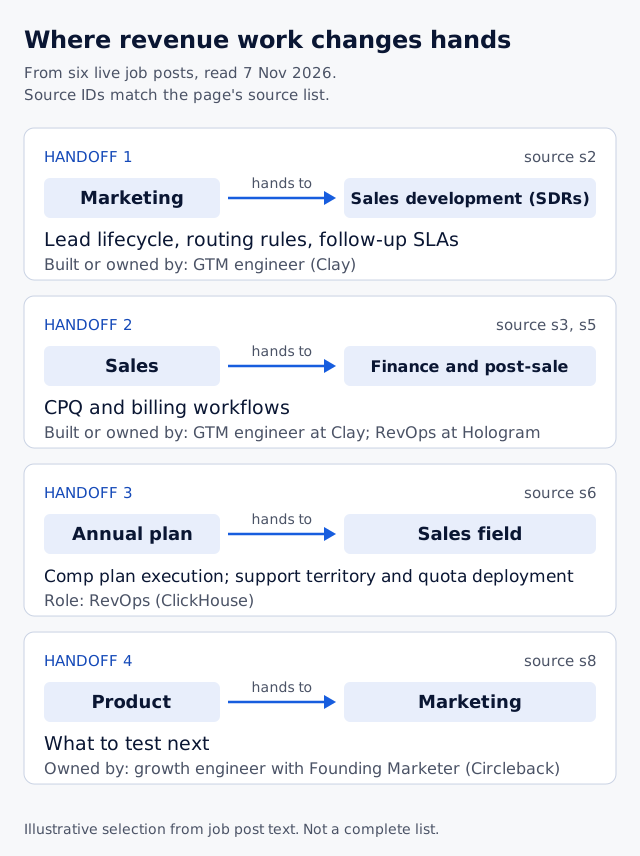
- Marketing to sales development. Clay's GTM engineer builds "lead lifecycle and handoff logic, routing and assignment rules, follow-up SLAs", plus the feedback loop that tells marketing which leads were worth working [2].
- Sales to finance and post-sale. Clay's Systems post asks for CPQ and billing workflows "ensuring clean handoffs between sales, finance, and post-sale teams" [3]. At Hologram the same seam belongs to RevOps, which reports into finance [5].
- Annual plan to the sales field. ClickHouse's RevOps analyst runs the comp plan cycle and supports the territory and quota deployment that put the annual plan in front of sales [6].
- Product to marketing. Circleback's growth engineer owns growth inside the product, its Founding Marketer "owns channels and brand", and the two decide what to test [8].
Clay's guide adds that most companies place their first GTM engineer inside RevOps, because RevOps already owns the data foundation [1].
Where the lines blur
- Clay's guide says a GTM engineer "does not need to write production code" [1]. Clay's own job posts still ask for the ability to build with Python, JavaScript, SQL or TypeScript [2] [3].
- Clay borrows from software teams too. A Clay article on X says its go-to-market engineers "adapted the way developers review and release code, calling it GTM CI/CD" [10].
- Clay's guide says RevOps keeps the existing motion running while GTM engineering changes it [1]. Hologram's RevOps post asks the hire to "decide what gets built and then build it, with AI agents and automation as first-class tools" [5].
- CPQ and billing work sits with GTM engineering at Clay and with RevOps at Hologram [3] [5]. The company decides the title, and the task stays the same.
My working definition vs the standard title
My title is AI GTM Engineer, and this is my own working definition, not a standard one: I build the AI systems that get a company recommended in AI answers and turn that interest into booked calls, using custom agents and tools I code myself.
Compared with Clay's definition [1], mine is narrower in one direction and wider in another. It leaves out RevOps work such as forecasting, comp and quote to cash, and it leaves out in-product growth code. It adds a question none of the six posts raise: whether a company shows up when buyers ask an AI assistant for a recommendation.
Which role fits which problem
- Leads arrive and sit unworked, or reps research accounts by hand: look at GTM engineering [2].
- Forecasts miss, nobody trusts the CRM, or quotes and invoices disagree: look at RevOps [5] [6].
- People sign up for a self-serve product and never reach first value: look at growth engineering [7] [8].
- On a small team with one hire, write down which of these problems costs you most and hire for that one. The titles overlap too much to hire on the title alone.
FAQ
Is a GTM engineer the same as RevOps?
No, though they overlap. In the posts we read, RevOps owns planning, forecasting and quote to cash [5] [6], and the GTM engineer builds automated pipeline workflows [2]. Clay's Systems post blends the two [3].
Do GTM engineers need to code?
Clay's guide says production code is not required [1]. Clay's job posts ask for Python, JavaScript, SQL or TypeScript [2].
Does a growth engineer do outbound?
Not in the two posts we read. Both focus on signup, activation and retention inside the product [7] [8].
What do these roles pay?
This page does not cover pay. A handful of job posts is not a salary benchmark.
We wrote these questions from points the sources contrast. Search data was not available for this page.
Sources, disclosure and changelog
Method note: this page comes from an AI-assisted research pass over public definitions, public job board posts and one captured X article.
Changelog: first version, with every job post live on the employer's board on the check date in the byline. Job posts close and change, so I aim to recheck them every two months.
The source table below lists every source with its access date.
| Ref | Source | Published by | Accessed |
|---|---|---|---|
| s1 | The Complete Guide to GTM Engineering (2026) | Clay | |
| s2 | GTM Engineer, Marketing (job post, published 12 Oct 2026) | Clay Labs | |
| s3 | GTM Engineer, Systems and Infrastructure (job post, published 9 Jun 2026) | Clay Labs | |
| s4 | What Is Revenue Operations (RevOps)? A Complete Guide | Salesforce | |
| s5 | Revenue Operations Manager (job post, first published 19 Oct 2026) | Hologram | |
| s6 | Senior Analyst, Revenue Operations (job post, published 10 Aug 2026) | ClickHouse | |
| s7 | Growth Engineer (job post, published 21 Sep 2026) | ClickHouse | |
| s8 | Growth Engineer (job post, published 27 Oct 2026) | Circleback | |
| s9 | What is Growth Engineering? | The Pragmatic Engineer (with Alexey Komissarouk) | |
| s10 | Agentic GTM: Learning loops & shipping like Software (X article, 2 Nov 2026) | Clay (X account @clay) |