

What this page covers
- Facts checked
- Sources
- 14 listed, with access dates
- Screenshots
- None on this page
- Score
- No numeric score on this page
Public documentation, announcements and one research paper read on 8 Nov 2026 in an AI-assisted research pass. Screenshots are documentation captures, not account interface tests.
What I checked
- Public Google, Microsoft and OpenAI documentation and announcements
- GEO paper (arXiv and HTML text)
Not covered
- No account, Search Console or Bing Webmaster Tools inspection
- No ranking, citation or crawler tests, no client data
- Perplexity's documentation was not assessed in this research pass
What the three terms mean
SEO is the oldest of the three. Google describes it as helping search engines understand your content and helping people discover your site (Google SEO Starter Guide).
AEO and GEO are newer. Google's guide to generative AI features uses both terms, expands them as answer engine optimization and generative engine optimization, and says: "From Google Search's perspective, optimizing for generative AI search is optimizing for the search experience, and thus still SEO." (Google guide, Markdown source). That statement covers Google Search only.
GEO also has a research meaning. Aggarwal and colleagues posted a paper on arXiv in November 2023, later published in the KDD 2024 proceedings, that frames GEO as improving content visibility in generative engine responses through a black-box optimization framework (arXiv abstract page, paper text). The authors report that the efficacy of the strategies they tested varies across domains. I treat that as a study result and not as a forecast for any real site.
None of these three terms has a standardized definition in the sources I read. In this page, AEO means work aimed at visibility in AI answer experiences, and the labels overlap. My editorial view: it is more useful to name the task and the engine than to argue over which label owns it.
The work, side by side
| Task | SEO | AEO (working label) | GEO (working label) |
|---|---|---|---|
| Objective | Help engines understand content and people find the site (Google). | Visibility in answer experiences; overlaps SEO and GEO (Google, Google). | Research framing: content visibility in generated responses (paper). |
| Crawl access and indexing (shared) | Core discovery and index eligibility (Google). | For Google AI features, a page must be indexed and eligible to be shown with a snippet, and the site must be included in Search generative AI features in Search Console (Google). ChatGPT search uses OpenAI's OAI-SearchBot (OpenAI). | Same retrieval foundation. The sources read describe no separate universal GEO index. |
| Content (shared) | Google recommends unique, helpful content (Google). | Google says you do not need to write in a specific way just for generative AI search (Google). Bing's guidance names depth, clarity, evidence, freshness and consistency; that is vendor guidance, not an independently tested ranking factor (Microsoft). | Same foundation. The paper tests content strategies against generated-answer visibility (paper). |
| Structured data and AI files (shared) | Existing markup should match the visible text on the page (Google). | Google says structured data is not required for generative AI search, there is no special schema.org markup to add, and no new machine readable or AI text files are needed to appear in Google Search (Google). | No special Google GEO markup. This review found no cross-engine markup requirement in the sources read. |
| Outcome measurement | Google's overall performance report includes AI feature impressions (Google). | Google has a dedicated generative AI report for AI Overviews and AI Mode (Google). Bing reports citations across supported surfaces (Microsoft). | The paper's visibility metrics apply to generated responses in a study. They are not Search Console impressions or Bing citations (paper). |
| Guarantee | Google lists indexing, snippet eligibility and Search Console inclusion as requirements for its AI features (Google). This review did not read those requirements as a promise of placement. | ChatGPT search placement is not guaranteed (OpenAI). | Study gains are domain-specific, not a promised uplift (paper). |
Controls are where the work stops overlapping, and the next table covers them.
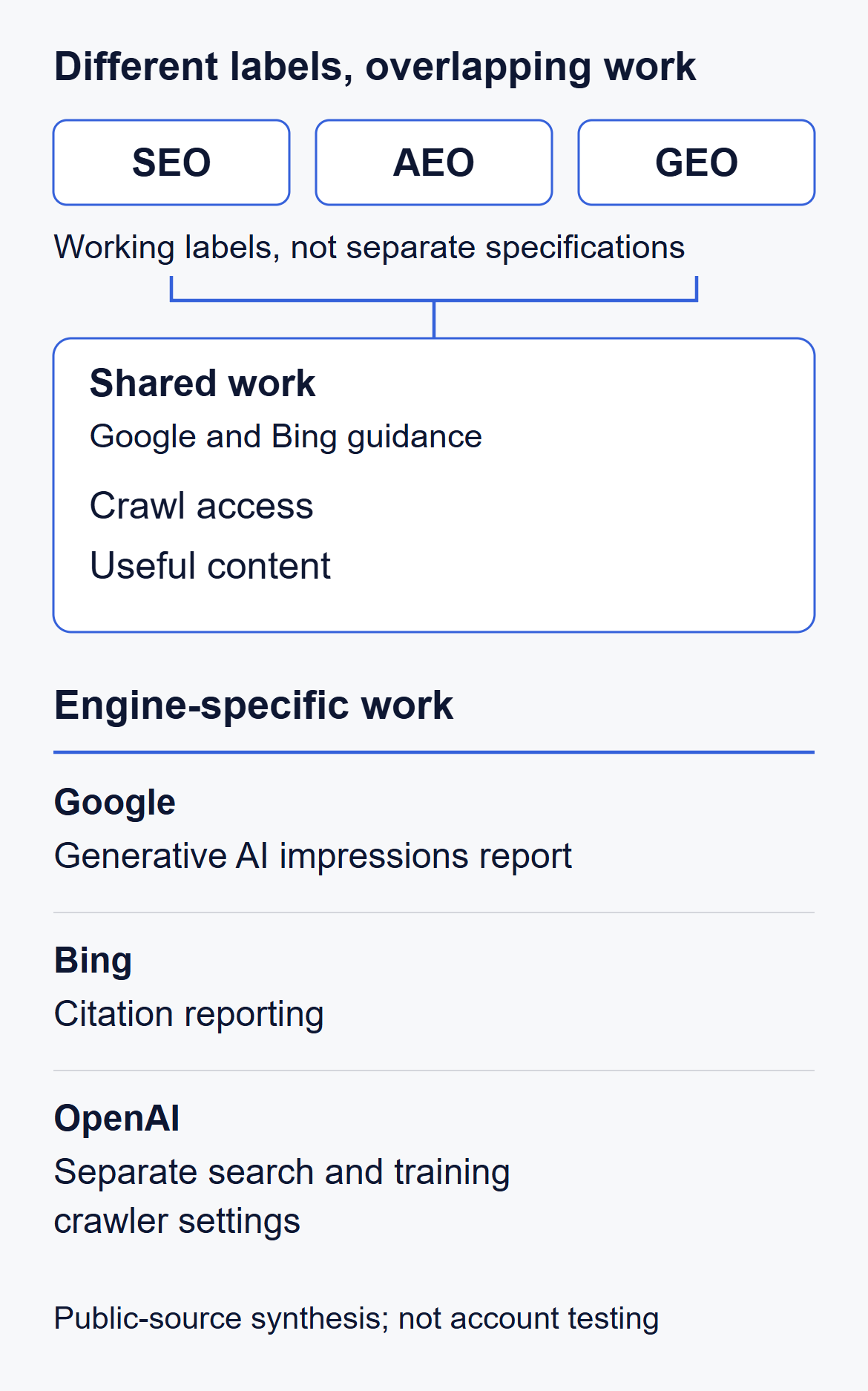
Controls and reports differ by engine
| Engine | Controls documented | What it reports | Coverage note |
|---|---|---|---|
| Googlebot robots.txt directives and snippet and noindex controls apply to Search AI features (Google). A separate Search generative AI control in Search Console defaults to include, and does not govern AI training; Google-Extended is referenced separately (Google). | A generative AI performance report with impressions for AI Overviews and AI Mode, by page, country, date and device, excluding Search Labs experiments (Google). The same data stays in the overall performance report (Google). | The report pages read do not establish prompt-level data or a separate AI click or conversion measure. | |
| Microsoft Bing and Copilot | Bing says it respects robots.txt and other supported controls (Microsoft). Microsoft announced new, independent training and grounding preferences on 30 October 2026. They take effect on 1 February 2027, as Microsoft crawls, so they were not in effect when this was checked (Microsoft). A September 2023 post describes NOCACHE, which limits answers to URL, snippet and title, and NOARCHIVE, which excludes content from Bing Chat answers; setting both is treated as NOCACHE (Microsoft). | AI Performance, in public preview, shows total citations, average cited pages and sampled grounding queries across Copilot, AI summaries in Bing and select partner integrations. It does not show placement within an answer (Microsoft). | Bing's help pages did not load for the research pass, so these points come from Microsoft's blog posts. The 30 October 2026 announcement says the 2023 NOCACHE and NOARCHIVE tags will be replaced for training and grounding starting 1 February 2027, and will no longer be read for that use after 1 March 2027. Check Microsoft's current help before changing anything. |
| OpenAI | OAI-SearchBot covers search, GPTBot covers training, and ChatGPT-User acts on a user's behalf; OpenAI says each setting is independent (OpenAI). Opting out of OAI-SearchBot keeps content out of ChatGPT search answers, though it can still appear as navigational links. ChatGPT-User is not used to decide whether content may appear in Search (OpenAI). OpenAI recommends allowing OAI-SearchBot in robots.txt and requests from its published IP ranges (OpenAI). Its search help also says the website host or content delivery network must allow traffic from the published searchbot IP addresses (OpenAI). | A publisher dashboard was not found in the sources checked. Placement is not guaranteed (OpenAI). | The sweep was incomplete, so not found is a coverage note, not proof that no dashboard exists. |
Until 1 February 2027, treat Microsoft's new preferences as announced and not yet effective. Keep the current controls in place until Microsoft's own help says otherwise.
Why the reports do not add up to one score
Google counts impressions of your pages in AI Overviews and AI Mode (Google). Bing counts citations, and its grounding queries are retrieval phrases drawn from a sample of citation activity, not a log of what people typed (Microsoft). The research paper measures visibility inside generated responses in its own study setup (paper). They are three different quantities. This page does not add them into one visibility score or a market share.
Where to start
This order is my editorial arrangement of what the sources describe. It is not a tested playbook.
- Confirm the basics Google names: pages are crawlable, indexed and eligible to show with a snippet, and the site is included in Search generative AI features in Search Console (Google).
- For each engine, read its control documents and decide search, training and user-fetch access separately where the engine splits them (Google, OpenAI).
- Keep structured data you already use matched to visible text. Do not add special AI markup or AI text files for Google, which says they are not needed (Google).
- Write unique, clear pages with evidence and examples (Google, Microsoft).
- Note which report each engine gives you and keep the numbers separate (Google, Microsoft).
- Put Microsoft's 1 February 2027 effective date in your calendar and recheck its help pages before then (Microsoft).
Common mistakes
- Assuming crawler access leads to a citation. OpenAI says ChatGPT search placement is not guaranteed (OpenAI).
- Allowing OAI-SearchBot in robots.txt while the website host or content delivery network still blocks its published searchbot IPs (OpenAI).
- Treating ChatGPT-User like the search crawler. OpenAI says it is not used to decide Search appearance (OpenAI).
- Taking Google AI impressions for clicks or citations. The report documents impressions (Google).
- Taking a Bing grounding query for the exact prompt a person typed (Microsoft).
- Describing Microsoft's announced preferences as live before 1 February 2027 (Microsoft).
- Adding an llms.txt file and expecting Google to need it. Google says it does not (Google).
- Using the GEO paper's reported gains as a forecast. The authors say results vary by domain (paper).
Tools and related pages
This page covers the work, not software. If you are choosing a monitoring tool, see Otterly vs Peec vs Profound and Ahrefs Brand Radar vs Semrush. For who owns this work inside a company, see GTM engineer vs RevOps vs growth engineer. All comparisons are on the comparisons hub, and the editorial methodology explains how pages like this are checked.
Questions people ask
Does GEO replace SEO?
Google says SEO best practices continue to be relevant for its generative AI features (Google) and that optimizing for them is still SEO from Google Search's perspective (Google). For other engines, this review read crawler and report documents only. The GEO paper's results are study-specific (paper).
Do I need special schema or an llms.txt file for Google AI answers?
Google says no. Structured data is not required, there is no special schema.org markup to add, and no new machine readable or AI text files are needed to appear in Google Search (Google). That answer covers Google Search only.
Can I allow ChatGPT search while blocking GPTBot training?
OpenAI documents separate settings for OAI-SearchBot and GPTBot and says each is independent (OpenAI). Check the current page before you edit robots.txt, and remember that allowing the crawler does not guarantee placement (OpenAI).
Can Search Console separate AI features from overall Web performance?
Google documents a generative AI performance report with impressions for AI Overviews and AI Mode, by page, country, date and device, and the same data remains in the overall report (Google, Google). The pages read do not establish a separate AI click or conversion measure.
Does a Bing grounding query equal the prompt a person typed?
No. Microsoft describes grounding queries as retrieval phrases, and the data is a sample of citation activity (Microsoft).
Does allowing an AI crawler guarantee my page will be cited?
Not in the cases these sources state. OpenAI says ChatGPT search placement is not guaranteed (OpenAI). Google lists indexing, snippet eligibility and Search Console inclusion as requirements for its AI features, and this review did not read those requirements as a promise of a citation (Google).
Coverage, gaps and changelog
Method: public documentation and announcements from Google, Microsoft and OpenAI, plus the GEO paper, were read on 8 November 2026 in an AI-assisted research pass. No account was signed in to, no Search Console or Bing Webmaster Tools data was inspected, and no ranking test, citation test or client data was used. I did not test any of this myself, and the page makes no performance claim.
Known gaps: Perplexity's documentation was not assessed in this research pass. Publisher dashboards for OpenAI were not found in the sources checked, and that sweep was incomplete. Bing's help pages did not load, so Bing points rest on Microsoft's blog posts. Source links go directly to the official pages and the cited paper.
Changelog: 8 November 2026, first version, then fact-check narrowed eligibility, report and Bing-control wording to the sources read.